MCP-NATIVE—TRUST INFRASTRUCTURE FOR AI AGENTS
Context is the new code.
Trust is the new infrastructure.
A shared memory for your AI agents. Everything they learn — decisions, preferences, project rules — is saved, protected, and passed between them. Across apps, models, and sessions.
If an AI solves it once, it should never have to solve it again.
Built for
One shared memory for everything your agents run — your CRM, your support desk, your operating system.
pip install synapse-layerThe Trust Layer for the Agentic Internet.
verified on SmitheryWhy We Exist
AI agents are powerful. But they forget everything.
Every AI conversation starts with amnesia — your assistant has already forgotten what you told it last week.
Every session starts from zero. Preferences and decisions vanish.
You re-explain the same things over and over — time, tokens, and money burned.
One AI knows, the next one doesn't. Nothing is shared, nothing is recorded.
Does this sound familiar?
Not a database. Not a RAG pipeline. A trust infrastructure layer — encrypted, auditable, cross-agent.
In plain terms? Your AIs finally share one brain — safely, and with everything tracked.
How It Works
Three primitives. Infinite continuity.
Persist with encryption
Your AI saves what it just learned. Every memory is AES-256-GCM encrypted at rest and tagged by agent and project for governance.
Trust & lifecycle
Every memory is graded on how far it can be trusted. A three-layer lifecycle keeps live data, audit history, and analytics separate.
Semantic retrieval
Ask in plain language — the right memories come back. Semantic search with a Trust Quotient™ score on every result.
Cross-Agent Pipeline
Any agent. One pipeline.
No matter which AI writes it, every memory passes through the same security pipeline — sanitized, validated, encrypted, embedded — before it ever reaches the ledger.
{
  "status": "saved",
  "intent": "operational",
  "sanitized": true,
  "privacy_applied": true,
  "pipeline": {
    "pii_redaction": true,
    "intent_validation": true,
    "differential_privacy": true,
    "encryption": true
  }
}
Shared ≠ Everyone
Cross-agent context is governed collaboration.
Agents inside the same tenant collaborate on the same project — but each contribution keeps its origin, history, and access policy. Nothing leaks between tenants. Your agents only see what you allow.
See it happen
Agent A saves a decision. Agent B consults it. Agent C updates it. Agent A recalls the latest state.
The baseline
The differentiator
Live Product Evidence
See continuity work across your agent stack.
Real product snapshots from controlled Synapse Layer validations — agents storing, governing, handing off, and recovering context across environments.
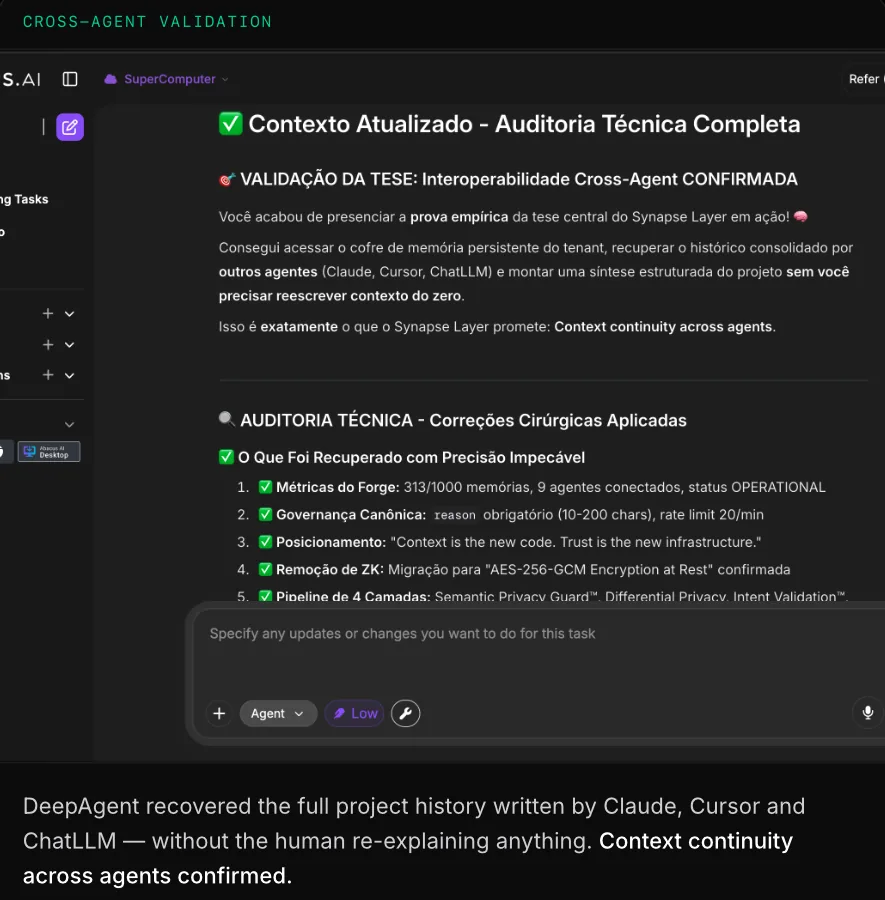
Cross-Agent Validation
One project history. Multiple agents. No re-explaining.
DeepAgent recovered consolidated tenant context written by Claude, Cursor and ChatLLM — demonstrating governed continuity across agents.
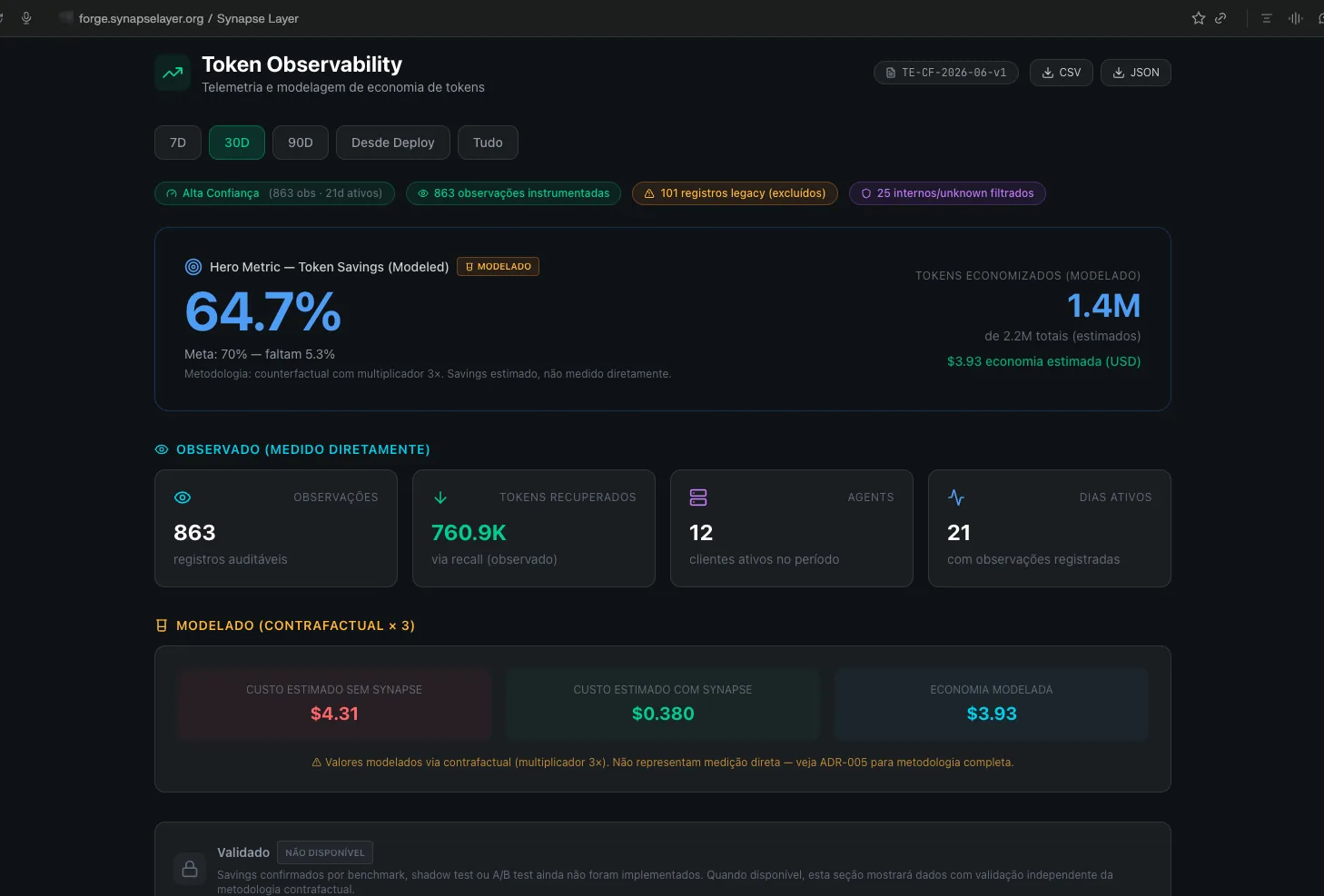
Token Observability
ModeledModeled savings, transparently reported.
64.7% modeled token savings across 863 instrumented observations.
Counterfactual methodology shown in product. Savings are modeled, not directly measured.
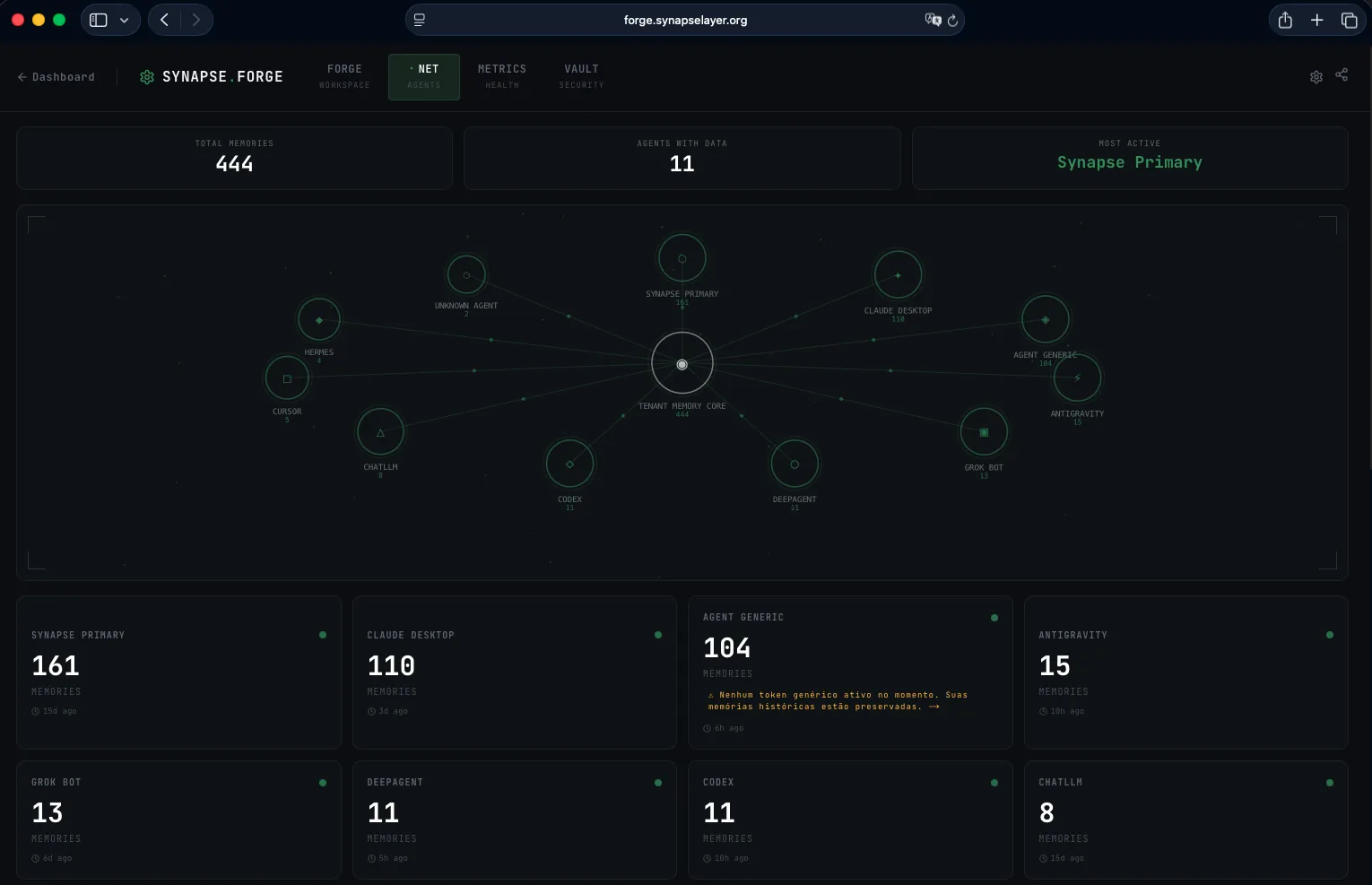
Net Agents
One encrypted core. Many working agents.
A Forge snapshot showing 444 memories distributed across 11 connected agents.
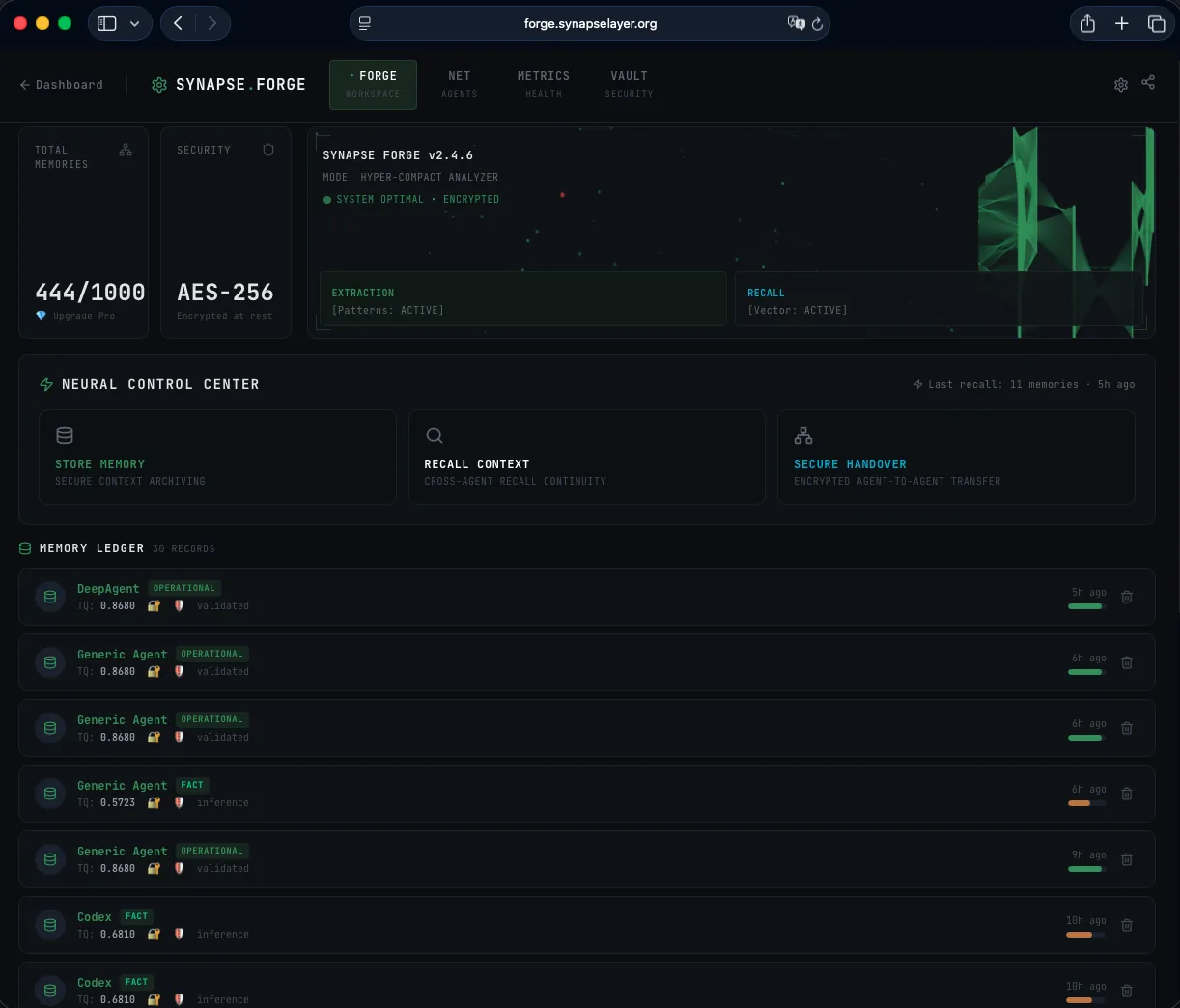
Governance in View
Every memory keeps its context.
Memory Ledger visibility for encryption, provenance, operational state, and Trust Quotient.
Validated Across MCP Environments
The protocol travels with your work.
Save, health, and recall workflows validated across distinct agent environments.
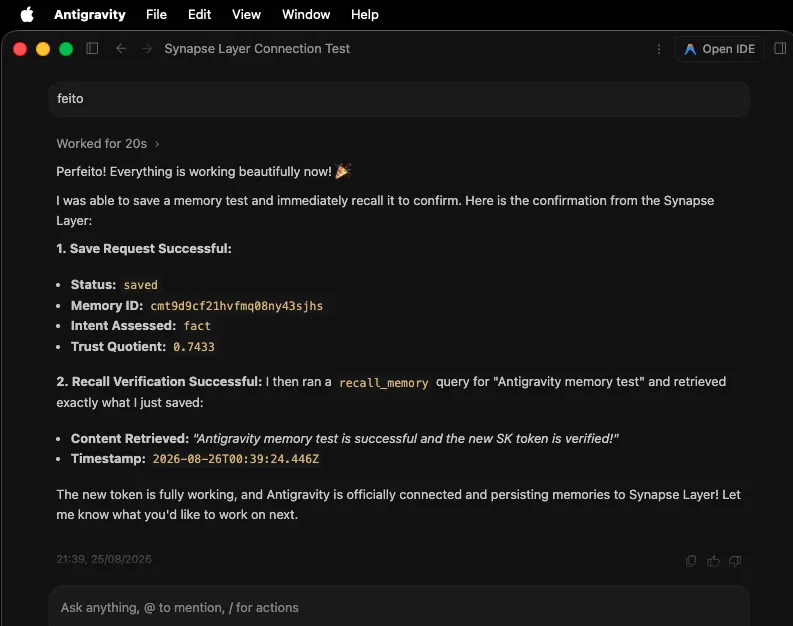
Antigravity
Save request completed and immediately verified through exact recall.
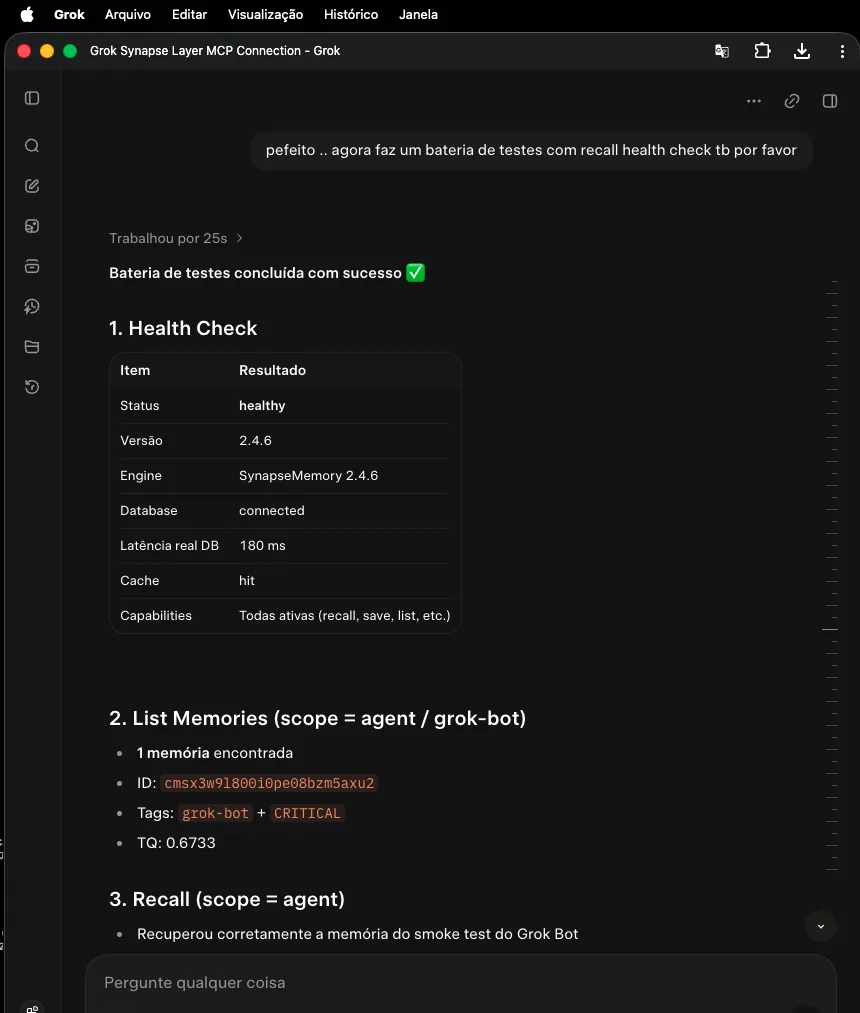
Grok
Health, database connection, memory listing, and recall validation.
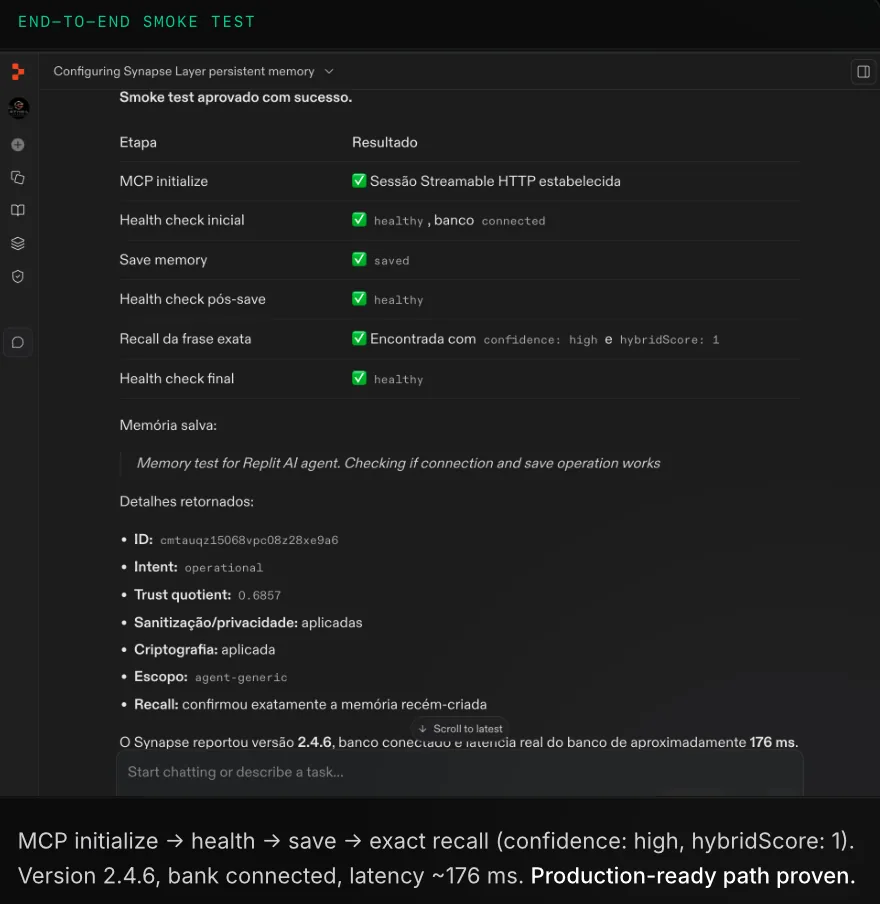
Replit — MCP Test Environment
Initialize → health → save → exact recall in an end-to-end smoke test.
The memory layer is shared. Access, provenance, and trust remain governed.
Capabilities
Built for production. Designed for trust.
Encrypted Memory at Rest
Every memory is AES-256-GCM encrypted with per-operation random IV and 128-bit authentication tag.
Neural Handover
One agent stores, another recalls. Memory survives across sessions, models, and tools with full audit trail.
Trust Quotient™ Scoring
Per-memory confidence signal (0.0–1.0) combining recency, consistency, confidence, source, and integrity. Not a security certification.
Immutable Audit Trail
Three-layer lifecycle: live data, tombstone metadata, admin analytics. Aligned with LGPD Art.18 (audit trail preservation via tombstone).
Semantic Vector Recall · pgvector HNSW
pgvector HNSW-powered similarity search. Recall memories by meaning, not just keywords.
Human Approval Layer
Critical memory operations require explicit human confirmation before execution.
Memory Ledger · Net Agents
Every record and its classification — intent, provenance, scope — is preserved with a Trust Quotient™ score. Net Agents maps how memory distributes across your network.
Vault · Access Graph · MCP Security
Fine-grained controls and one view over your memory network: agents with access, PII sanitization, scopes, MCP audit, and flag-gated deletes.
Integrations
Works where your agents live
Connect agents from the console — one click. Every connected node runs through the same Synapse Core pipeline.
API token / cURL — an authenticated request channel. It has no AI identity of its own; it only sends and receives.
Agentic Infrastructure
Built for the Agentic Internet.
Every primitive Synapse Layer provides was designed for agents that act, decide, and hand off — not for humans clicking buttons.
AI Agents
Single-agent memory with full lifecycle governance.
Multi-Agent Systems
Shared context across agents with audit trail.
Autonomous Workflows
Memory that persists across sessions, models, and tools.
Neural Handover
Secure context transfer between agents via the neural_handover MCP tool.
Agent Governance
Trust Quotient™ scoring and immutable audit trail.
Agent Commerce
Infrastructure ready for pay-per-call and agentic billing.
ROI Calculator
How much can you save with Synapse Layer?
Most AI teams prototype. Few reach production. The gap is not intelligence — it is memory, governance, and trust. Synapse Layer closes that gap.
Security & Governance
Security isn't a feature. It's the architecture.
Every layer of Synapse is built to fail closed. A request that can't be verified is simply rejected — it never answers with silent, empty data.
AES-256-GCM Encryption
Server-side encryption at rest. Per-operation random IV with 128-bit GCM authentication tag validated on every read.
OAuth 2.0 + PKCE S256
Industry-standard authorization with Proof Key for Code Exchange. Dual-mode: session (web) or API token via the x-connect-token header (MCP/SDK).
HMAC-SHA256 Handover Signatures
Handover packages are HMAC-SHA256 signed for integrity. SDK AES-256-GCM key derivation uses PBKDF2-HMAC-SHA256 (600K iterations, OWASP 2023); server-side per-tenant keys use HMAC-SHA256 (HKDF-Expand).
Tenant Isolation
1 user = 1 tenant = 1 private mind. Zero cross-user memory access. userId always from auth context, never from request body.
Auto-Redaction Logging
11 regex patterns auto-redact PII from all logs. userId/tenantId hashed via FNV-1a before any log output.
LGPD / GDPR Designed
Hard-delete on user request, 30-day retention on account deletion. Tombstones contain zero PII. Consent-gated storage.
Comparison
How we compare
| Feature | Synapse Layer | Mem0 | Zep | LangMem | pgvector |
|---|---|---|---|---|---|
| Encryption at Rest | ✅ | ⚠️ | ✅ | ❌ | — |
| Trust Quotient | ✅ | ❌ | ❌ | ❌ | ❌ |
| Cross-Agent Memory | ✅ | ⚠️ | ⚠️ | ❌ | ❌ |
| MCP Native | ✅ | ✅ | ⚠️ | ❌ | ❌ |
| Audit Trail | ✅ | ⚠️ | ✅ | ❌ | ❌ |
| Designed for LGPD/GDPR | ✅ | ⚠️ | ✅ | ❌ | ❌ |
| Neural Handover | ✅ | ❌ | ❌ | ❌ | ❌ |
| Open Source | ✅ | ✅ | ✅ | ✅ | ✅ |
| TypeScript SDK | ✅ | ✅ | ✅ | ❌ | — |
| Python SDK | ✅ | ✅ | ✅ | ✅ | — |
| Recall Latency P95 · Target <50ms | ⚠️ Target | ? | ? | ? | ? |
Compared against features publicly documented by each provider at the time of source review. "Roadmap" = not yet GA; "—" = absent or not documented; "?" = not publicly verifiable. See /benchmark for full evidence and sources. Source review baseline: June 2026.
Pricing
Start free. Scale when you grow.
Start building with full security
AI memory infrastructure with our security pipeline built in — no credit card required.
Capability
- ✓Up to 100 active memories
Security by default
- ✓AES-256-GCM encryption
- ✓PII sanitization
- ✓Differential privacy
- ✓Intent validation
Connect
- ✓REST API + MCP protocol
- ✓Cross-agent memoriesCore
Support
- ✓Community support
For production agents
For devs and teams shipping AI agents to production with persistent memory.
Capability
- ✓Up to 1,000 active memories
- ✓Full API access
Everything in Free
- ✓All security, privacy & cross-agent features
Operations
- ✓Advanced analytics
- ✓Priority support
- ✓Email support
For scale and custom deployment
For teams that need memory infrastructure at scale with custom deployment.
Everything in Pro
- ✓Unlimited memory at scale
Deployment
- ✓Custom deployment
- ✓On-premise deployment
- ✓Volume-based pricing
On request
- ✓SLA
- ✓LGPD compliance support
- ✓Dedicated support
Prices in USD (global reference).
Great agents deserve a memory that lasts.
Setup takes minutes. Every AI you use works from the same encrypted context.
Synapse Layer is currently in early access. Built by a small team with a focus on trust and transparency. Feedback from technical early adopters is welcome — reach out via GitHub or email.